1899 Manifesto Asserting Independence: A Document That Hinted A Brewing Conflict
1899 Manifesto Asserting Independence: A Document That Hinted A Brewing Conflict
Diana A. Galang
How much are you willing to give to defend your freedom? A manifesto from 126 years ago may just remind us that, at least for revolutionary Filipinos, they are willing to give all.
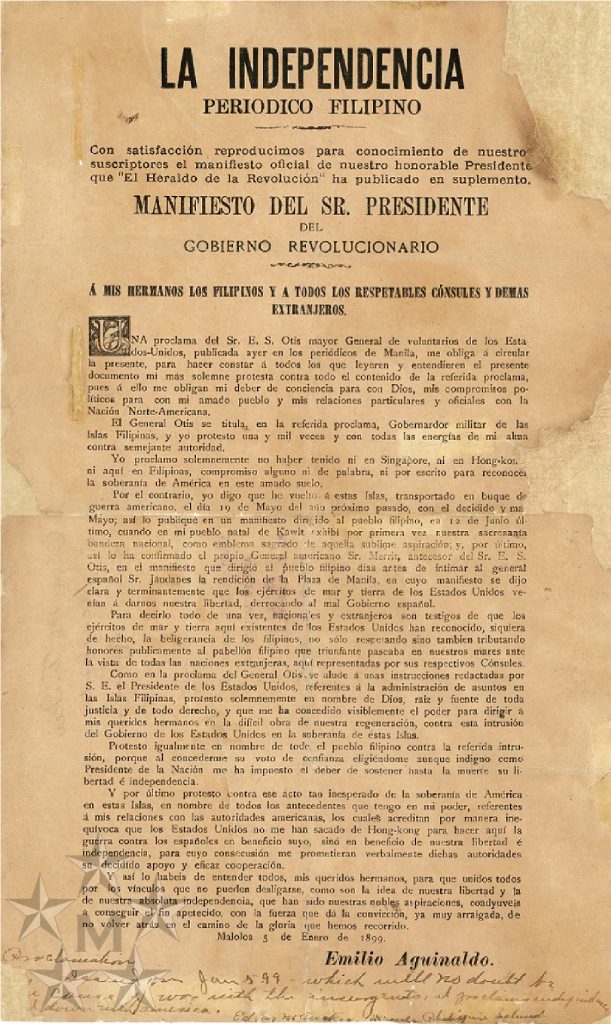
On 5 January 1899, President Emilio Aguinaldo issued a Manifesto addressed to all Filipinos and to the whole world that the Philippines is ready to defend their recently-won independence. A copy was published in La Independencia and is now available at our National Memory Project.
But why did Aguinaldo have to issue such a passionate statement?
From Friends to Enemies
As far as Filipinos are concerned, the Americans came into the picture when it declared war against Spain in the aftermath of the explosion and sinking of the USS Maine in the harbor of Havana, Cuba on 15 February 1898.
Although a truce has been signed in Biak-na-Bato, the war became an opportunity for revolutionaries to finally oust the Spaniards. After Admiral George Dewey decisively defeated the Spanish fleet on 1 May, Aguinaldo came back to the country. He believed the verbal statement Dewey gave him that the United States needed no colonies and that it would recognize Philippine independence.
Confident of American support, Aguinaldo relaunched the revolution and established a government in areas liberated from Spanish rule. He formally proclaimed independence in his home in Kawit on 12 June, convoked an assembly of local representatives in Bacoor on 1 August, and formed a constitutional convention in Malolos in 15 September.
Emboldened by the freedom of the press, Antonio Luna established La Independencia, considered the most influential newspaper in the liberated nation. Joining him are many other nationalist Filipinos who wrote both prose and poetry to rouse the nationalist feeling of their readers, and gave reports on local and international events.
Yet amidst all this, the Americans and the Spaniards were already engaged in talks in which the latter would surrender the administration of the archipelago to the former. This was formalized in the Treaty of Paris on 10 December. A few weeks later, U.S. President William MacKinley issued the Benevolent Assimilation proclamation on 21 December. This text was distributed in the Philippines by Major General Elwell Stephen Otis on 4 January 1899, although several copies were recalled with the intention of substituting it with a softened edition.
Aguinaldo’s response was swift. The very next day, he released a manifesto in which he detailed the events which led to his return to the country. He stated that he did not have any written or verbal consent to American sovereignty and that he protests their intrusion in the administration. He also emphasized that the Philippines is free and independent from the United States.
In addition to copies printed by the Imprenta Nacional and its publication in the government-owned El Heraldo de la Revolucion, the manifesto was also printed in La Independencia.
How We Got a Copy
On 5 February 2024, Consul General Iric Cruz Arribas of the Embassy of the Philippines in Washington sent an email to the NHCP informing us about the existence of an original copy of the issue of La Independencia which contains Aguinaldo’s Manifesto.
This prompted us to coordinate with the Director of MacArthur Memorial Museum, Ms. Amanda Williams, and they permitted us to share a digital copy in the National Memory Project. It can now be viewed through this link: https://memory.nhcp.gov.ph/?s=manifesto#item68502_1. The Museum will also send a facsimile of for public viewing soon.
According to the Museum, the document was part of the scrapbook gifted to Gen. Douglas MacArthur in 1958. The said documents together with other items were donated to the Museum in 1964. The copy of the manifesto was ripped down from a wall in Manila and was kept by an American soldier, Edgar M. Tucker. On the bottom part of the document Tucker wrote: “Issued on January 5 – ’99, which will no doubt be the cause of war with the Insurgents.” The statement indeed came true as about a month later, the Philippine-American War began.
Indeed, this document is a proof of our forefathers’ courage and fortitude to fight for its independence. It serves as a testament of the complex yet strong relationship that has evolved between the two nations, from a complicated beginning to a partnership that both nations value.
References:
“Collection Highlights: Spanish-American War Philippine-American War.” MacArthur Memorial, 28 June 2024. https://www.flipsnack.com/FE7AC7BBDC9/macarthur-memorial-span-am-war-and-phil-am-war-collection-guide/full-view.html.
Harper’s History of the War in the Philippines. New York : Harper & Brothers Publisher, 1900.
Zaide, Gregorio. Documentary Sources of Philippine History, volume 9. Manila : National Book Store Inc, 1990.
______________. Documentary Sources of Philippine History, volume 10. Manila : National Book Store Inc, 1990.